• Home
  • Services
  • About
  • Lab
  • Contact
CentralStatz Lab

Better analytical ideas, made tangible.

A focused space for exploring healthcare analytical problems and what becomes possible when implementation is no longer the primary constraint.

Each project begins with a real analytical problem, not a basic technology demo. Rigorous reasoning defines the structure; rapid, AI-assisted development makes alternative ways of framing and solving it tangible early enough to test.

Explore active projects Work with CentralStatz

LAB / 001Current operating model
What should analytical work make possible?
01ReasonFrame the question
02BuildMake it tangible
03TestExpose it to reality
↳ Building the idea makes it testable. It does not make it right.
01 / Active work

Working hypotheses, made inspectable.

Projects are published while they are still becoming. Status, limitations, and next questions are part of the work.

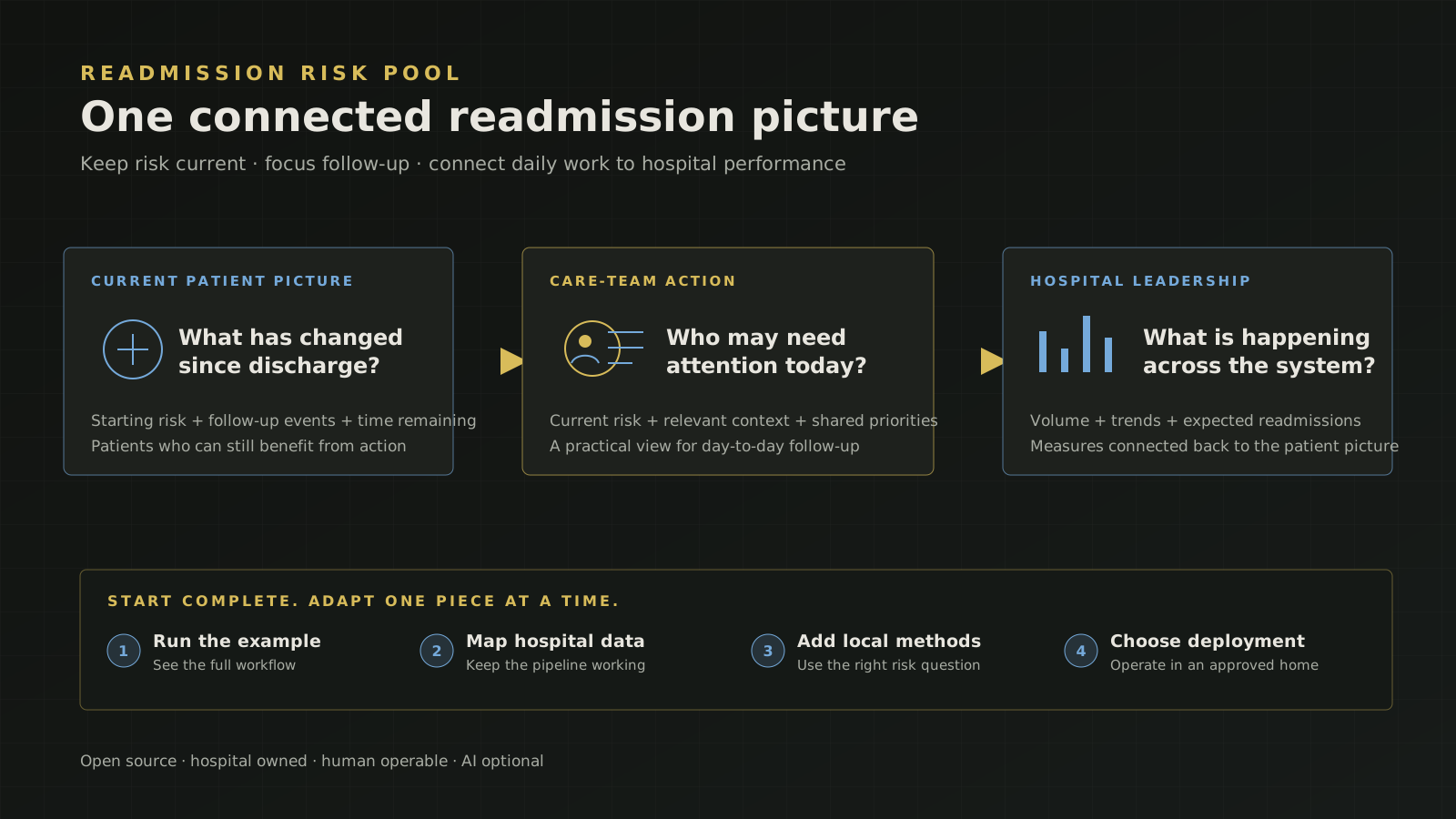
Diagram connecting a current patient picture to care-team action and hospital leadership insight, followed by four incremental implementation steps Concept diagram
Active Development Hospital readmission management

Readmission Risk Pool Platform

An open-source way for hospitals to keep readmission risk current, help care teams focus follow-up, and connect day-to-day work with the larger hospital picture.

Question Concept Prototype Validation Pilot Production
Central question

Can a hospital manage readmissions from one current, connected view—supporting daily follow-up and leadership decisions without surrendering its data, methods, or workflow to a fixed vendor tool?

Current state

The public v0.1.0 Hospital Implementation can be installed and run with fictional data to exercise the full path from source inputs and risk updates to history, analytical products, and a web application.

Latest update

The first public Platform and Hospital Implementation releases provide a working reference application, a hospital-owned customization path, and generation of a validated repository prepared for Posit Connect Cloud setup.

Next experiment

Add and validate a container-based deployment path so hospitals can more directly move generated application artifacts into their own approved environments.

Known limits: The included data and reference risk method are fictional and nonclinical. Real hospital use still requires local data mapping, model validation, privacy and security review, deployment approval, workflow design, and clinical governance.

Looking forFeedback from hospital quality, care-management, analytics, operational, and executive leaders on the decisions and workflows this shared view should support

Open project notebook →
No matching items
02 / Method

Building is part of the reasoning.

A prototype creates something concrete enough for users, experts, evidence, and constraints to push against.

  1. 01

    Observe

    Identify a recurring healthcare analytical problem or workflow that should work better.

  2. 02

    Reason

    Clarify the question, clinical or operational context, inherited assumptions, users, evidence, and whether a simple structure is sufficient.

  3. 03

    Prototype

    Make one or more possible structures tangible enough to compare, question, and test.

  4. 04

    Test

    Put it in front of users, domain experts, data, and real-world constraints.

  5. 05

    Evolve

    Improve it, pause it, publish what was learned, or develop it further.

03 / AI’s role

Faster implementation changes more than speed.

AI-assisted development can reduce the distance between a well-reasoned healthcare problem and a working analytical system. More importantly, lower implementation cost expands the set of solutions worth considering before one structure becomes expensive to replace.

The goal is not maximum sophistication. It is less compromise for the wrong reasons. Statistical reasoning, domain expertise, validation, and judgment still determine what should be built.

Acceleration

  • analytical code + interfaces
  • rapid design comparison
  • testable analytical artifacts
  • faster reasoning–use iteration

Expanded possibility

  • reconsider project scope
  • represent states + trajectories
  • compare analytical formulations
  • problem determines machinery
S / S

04 / Philosophy

Structure Before Sophistication

Sophisticated-looking outputs are becoming easier to generate. Understanding the healthcare problem, defining what should be measured, making assumptions explicit, and determining how the work will be used are not.

Expanded technical capability does not make complexity inherently better. A simple method is still the right method when it matches the question, data, and decision. Get the structure right first, then add complexity only where it improves the solution.

Clear questionsStart with the healthcare question and the decision it needs to support.
Defensible logicMake definitions, metrics, assumptions, and analytical choices open to review.
Reproducible systemsBuild work that can be understood, repeated, and maintained.
Honest boundariesMake uncertainty, limitations, and appropriate use part of the system.
05 / Participate

Help shape what the work becomes.

Test an artifact, question an assumption, offer methodological perspective, or bring a real analytical problem into conversation.

TestExplore a projectInspect active work and its stated boundaries. RespondShare feedbackBring domain, analytical, or usability perspective. DiscussBring a problemStart with the primary CentralStatz contact workflow. ContextAbout AlexLearn about the experience behind CentralStatz and the Lab.

© 2026 CentralStatz Statistical & Data Sciences LLC · Wausau, Wisconsin

Home · Services · About · Contact · Lab